Research, explained
The Gut-Eye Axis: What Early Research Shows, and What It Does Not
The gut-eye axis is the idea that gut bacteria may be linked to eye health. Studies have found that people with some eye diseases have different gut bacteria, but no one has shown that one causes the other. Probiotic approaches are still investigational. VisiFlora uses the gut-eye pitch but names no probiotic.
Written by the VisiFlora editorial teamUpdated · 7 min read

The idea
What is the gut-eye axis?
The gut-eye axis is a research idea: the bacteria living in your gut may be connected to what happens in your eyes. It is an open question, not a settled fact.
Your gut holds a large community of microbes, often called the gut microbiota. The eye is a newer topic in that research.
A 2021 review pulled together the early studies. It reports growing evidence that eye disease is associated with altered gut bacteria (Review: gut microbiota and eye disease (early research)). It says the link still needs an explanation of how it works.
Where the science stands
What does gut-eye research actually show?
It shows patterns, not proof. People with some eye diseases tend to have different gut bacteria, but the studies cannot yet say why.
| Question | What the research says | Strength |
|---|---|---|
| Do people with eye disease have different gut bacteria? | Growing evidence of an association (Review: gut microbiota and eye disease (early research)) | Early |
| Do gut bacteria cause eye disease? | Unclear whether a causal relation exists (Review: gut microbiota and eye disease (early research)) | Unproven |
| Do we know how a gut-eye link would work? | It still needs a solid mechanistic foundation (Review: gut microbiota and eye disease (early research)) | Unknown |
| Do probiotics help the eyes? | Probiotic approaches are investigational (Review: gut microbiota and eye disease (early research)) | Not shown |
| Which probiotic strain or dose? | Best strains and doses are unknown for many uses (NCCIH: probiotics) | Unknown |
Cause or pattern?
Do gut bacteria cause eye disease?
No one knows yet. The review that maps this field says it is still unclear whether a causal relation truly exists (Review: gut microbiota and eye disease (early research)).
A link is not the same as a cause:
- Eye disease and gut changes may both follow age, diet or other illness.
- Medicines taken for one condition can change gut bacteria.
- A study that looks once at a group of people cannot tell which change came first.
Until controlled trials answer it, the gut-eye axis is a lead, not a plan for your eyes.
Probiotics
Can a probiotic help your eyes?
There is no good evidence that it can yet. Probiotic approaches for eye disease are still investigational (Review: gut microbiota and eye disease (early research)).
Even outside the eye, the picture is mixed. NCCIH says probiotics show promise for a few uses, such as diarrhea linked to antibiotics, but the evidence is inconclusive for many conditions. The best strains and doses are unknown (NCCIH: probiotics).
Probiotic risks are greater for people who are severely ill or have weakened immune systems (NCCIH: probiotics). Talk with your doctor before you start one.
The bottle
Is there a probiotic in VisiFlora?
No. The sales page names 21 ingredients, and none is a probiotic or bacterial strain. Tap the lines below to see what is listed.
What the seller lists
Typed from the sales page · No Supplement Facts panel is published
The sales page direction. The brand graphics show 30 capsules per bottle, so one bottle lasts about 30 days.
The only amount the seller publishes. It equals the RDA for men (8 mg for women), is far under the 40 mg upper limit, and is far below the 80 mg used in AREDS.
AREDS2 used 10 mg of lutein and 2 mg of zeaxanthin. Without amounts, no one can compare VisiFlora with it.
Small eye-strain studies used 4 to 12 mg a day. Most astaxanthin research is in animals.
Rigorous trials found no night-vision benefit in healthy people.
AREDS2 left beta-carotene out. The original AREDS formula with beta-carotene is not recommended for current or former smokers.
AREDS2 used vitamin C 500 mg, vitamin E 400 IU and copper 2 mg.
Ginkgo may raise bleeding risk with warfarin and other blood thinners.
Alpha-lipoic acid may lower blood sugar and add to diabetes medicines.
The sales page claims 22 ingredients and names 21. No probiotic is named, despite the gut-eye pitch.
Not published. The capsule shell and any fillers are not listed.
Typed from the sales page (Sales page, tryvisiflora.com), not from a label photo. Check the panel on your own bottle.
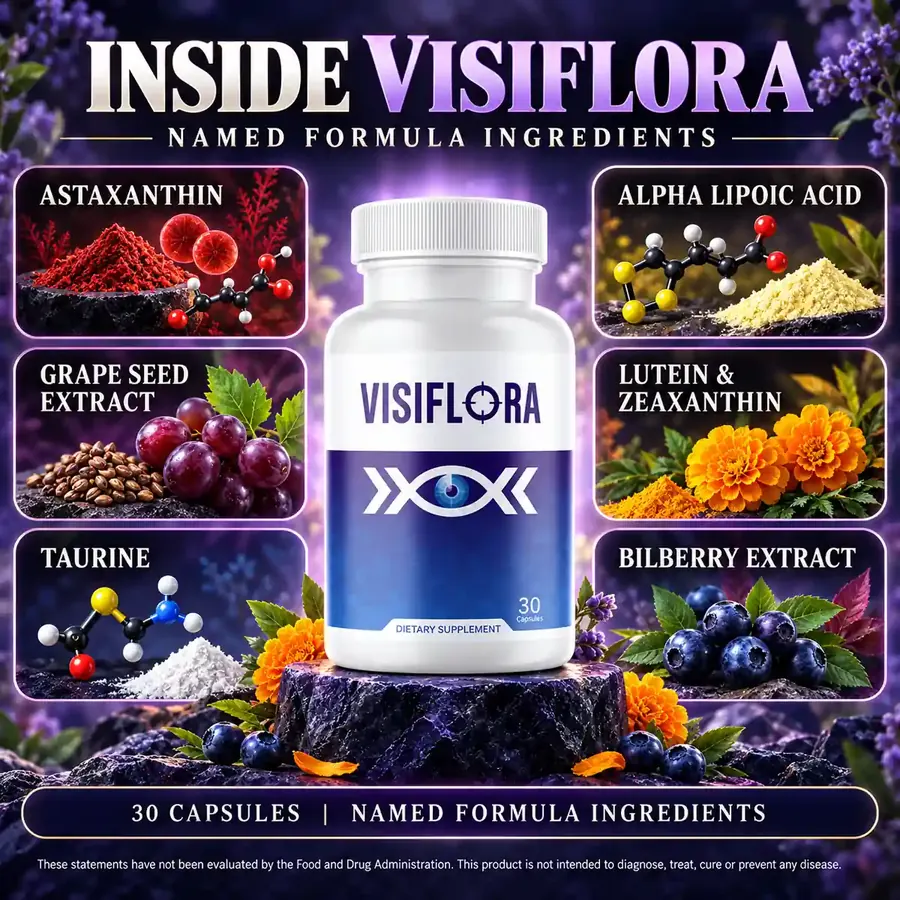
Tap a line to see what it means. The brand graphic names six headline ingredients and shows 30 capsules; it gives no amounts.
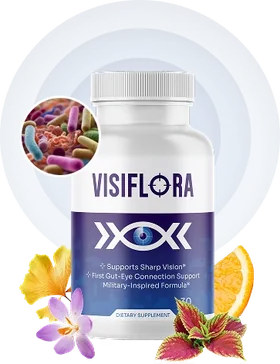
The bottle front says "First Gut-Eye Connection Support". The sales page does not explain which listed ingredient acts on the gut. Read the full list of what the label shows.
Try VisiFlora for 60 days1 capsule a day with food · from $49 a bottle · free U.S. shipping on 3 or 6 bottles
Order nowReading the claim
What does "First Gut-Eye Connection Support" mean?
It is a marketing line on the bottle, not a study result. No trial has tested VisiFlora, and the gut-eye link itself is unproven as cause and effect (Review: gut microbiota and eye disease (early research)).
The FTC says health claims for supplements need competent and reliable evidence, usually randomized, controlled human trials (FTC: health product advertising rules). Testimonials never count as that evidence.
Our claims, checked page compares each bottle line with the evidence.
What you can do now
What helps your eyes while gut-eye research catches up?
The basics with solid support. NEI calls a dilated eye exam the single best thing you can do for your eyes (NEI: everyday ways to keep eyes healthy).
- Eat leafy greens and fish rich in omega-3s (NEI: everyday ways to keep eyes healthy).
- Add kale, spinach, corn and eggs for lutein and zeaxanthin (Review: lutein and zeaxanthin in foods).
- Do not smoke, and wear sunglasses that block 99-100% of UVA and UVB (NEI: everyday ways to keep eyes healthy).
Our eye health guide lays out the full plan by age.
Safety
When do eye symptoms need a doctor instead of a supplement?
Any new or lasting eye symptom needs an exam, not a capsule. Some need care the same day.
A sudden shower of floaters, flashes of light or a shadow over part of your vision can mean retinal detachment, a medical emergency (NEI: urgent warning signs). Go to an eye doctor or emergency room right away. Scratchy, burning eyes may be dry eye (NEI: dry eye). For the nutrients with real trial data, read what AREDS2 means.
FAQ
Gut-eye axis questions, answered
What is the gut-eye connection?
It is the idea that gut bacteria may be linked to eye health. A 2021 review found eye disease is associated with altered gut bacteria, but it remains unclear whether either causes the other, and the link needs a solid mechanistic basis (Review: gut microbiota and eye disease (early research)). It is early research.
Does VisiFlora contain probiotics?
No probiotic is named. The sales page lists 21 ingredients, including carotenoids, plant extracts, herbs, vitamins and minerals, but no bacterial strain (Sales page, tryvisiflora.com). If gut health is your goal, ask your doctor, since probiotic evidence is inconclusive for many uses (NCCIH: probiotics).
Can probiotics improve eyesight?
There is no evidence that they can. Probiotic approaches for eye disease are still investigational (Review: gut microbiota and eye disease (early research)), and for many conditions the best strains and doses are unknown (NCCIH: probiotics). Blurry or changing vision needs a dilated eye exam to find the cause.
Is gut-eye research proven?
No. It is early research. Studies show associations between gut bacteria and some eye diseases, but cause and effect has not been shown (Review: gut microbiota and eye disease (early research)). Products that lean on the gut-eye idea are ahead of the science, and the FTC expects human trials behind health claims (FTC: health product advertising rules).
What foods support eye health?
Leafy greens and fish are NEI's main food tips (NEI: everyday ways to keep eyes healthy). Kale, spinach and parsley are rich in lutein, and corn and eggs supply both lutein and zeaxanthin (Review: lutein and zeaxanthin in foods). One cup of cooked spinach has about 29.8 mg of the two together (Linus Pauling Institute: carotenoids).
Why does VisiFlora talk about the gut if it has no probiotic?
The sales page does not say. It uses "First Gut-Eye Connection Support" on the bottle but names no probiotic and links no listed ingredient to the gut (Sales page, tryvisiflora.com). Treat the line as marketing until the seller publishes evidence and a full label.
Who wrote this
Written and reviewed by
Plain-language pages built from what the seller publishes and from linked eye-health sources.
Last updated . Read our editorial standards and how we check reviews. This website is run by a USA authorized VisiFlora retailer, not by the manufacturer. We earn money when you buy through our order links.
Keep reading
More about VisiFlora
Claims, checked
Every VisiFlora claim beside the research: what is shown, what is early, and what is just marketing.
Read moreIngredients
All 21 named ingredients in 12 groups, with research amounts and the main caution for each.
Read moreAstaxanthin and eye strain
What small studies found about astaxanthin and tired eyes, the doses they used, and what VisiFlora does not publish.
Read moreUSA authorized VisiFlora retailer
Ready to try VisiFlora?
Pick a pack. Every pack covers at least the 60-day money-back window at one capsule a day.
- Secure BuyGoods checkout
- 60-day money-back window
- Ships from the U.S. with tracking