Ingredient profile
Ginkgo and Other Herbs in VisiFlora
VisiFlora lists four herbs: ginkgo biloba, saffron extract, eyebright and coleus forskohlii, with no amounts. The key fact is a caution: ginkgo may raise bleeding risk with warfarin and other blood thinners. NCCIH lists no eye conditions among ginkgo's evidence topics, and our sources hold no research on the other three herbs.
Written by the VisiFlora editorial teamUpdated
The basics
What is ginkgo biloba in VisiFlora?
It is an extract of the ginkgo tree's leaf, listed on the sales page as "Ginkgo Biloba" with no amount (Sales page, tryvisiflora.com). The seller sells it for blood flow.
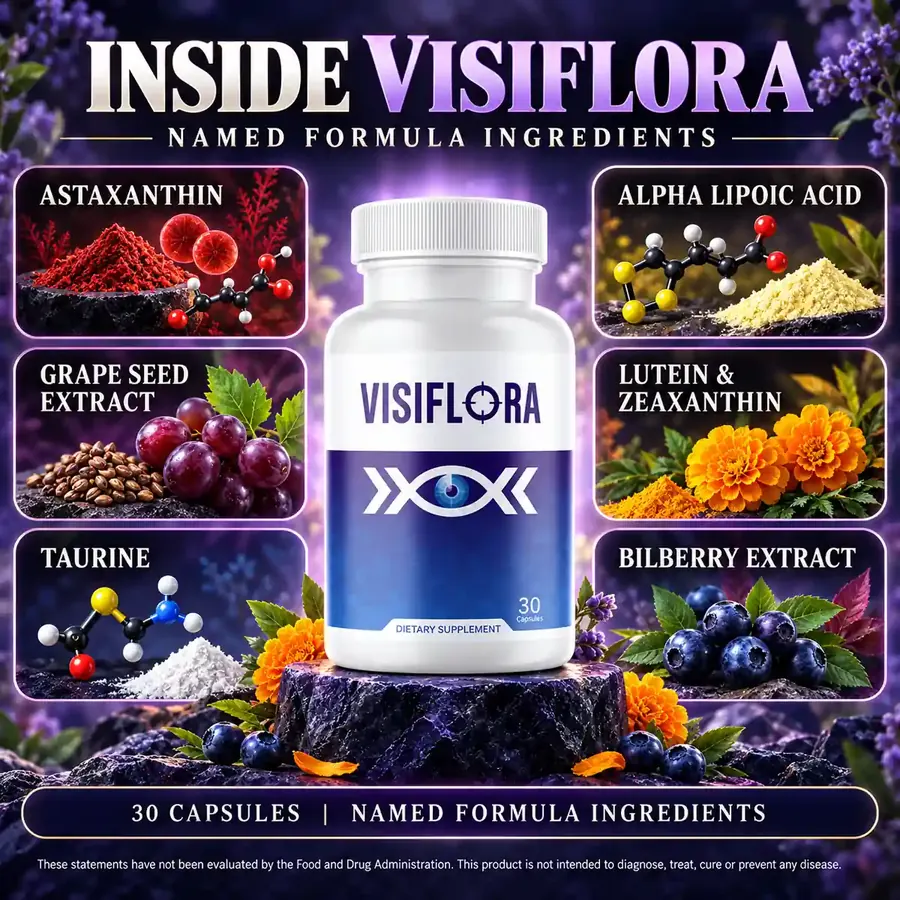
Ginkgo is one of four herbs in the formula. The other three are saffron extract, eyebright and coleus forskohlii. None of the four appears on the brand's six-tile ingredient graphic, and none has a published amount.
Ginkgo comes first on this page because it has the clearest safety caution of the four.
| Name on the sales page | Ginkgo Biloba |
|---|---|
| What it is | Ginkgo biloba leaf |
| Type | Herbal extract |
| Amount per capsule | Not published |
| Amount used in research | NCCIH lists no eye conditions among its evidence topics |
| Strength of evidence | Not established for eyes |
| Why it is in the formula | Sold for blood flow |
| Main caution | May raise bleeding risk with warfarin and other blood thinners. |
The evidence
Does ginkgo improve blood flow to the eyes?
No source we cite shows that it does. NCCIH's ginkgo page does not list eye conditions among its evidence topics (NCCIH: ginkgo).
The sales page and its upsell page make a specific blood-flow claim for ginkgo and coleus, with a percentage attached. They cite no study for it, so we do not repeat the figure (Sales page, tryvisiflora.com). Health claims like this need randomized human trials to back them (FTC: health product advertising rules).
See how every sales-page claim stacks up on our claims page.
Safety first
Is ginkgo safe with blood thinners?
Not without your doctor's OK. Ginkgo may raise bleeding risk in people taking warfarin or other anticoagulants, and it may interact with other drugs too.
- 01
List every medicine
Write down each prescription, aspirin or other pain reliever, and every supplement you take.
- 02
Show the bottle
Take the VisiFlora bottle to your doctor or pharmacist. Point out that it lists ginkgo.
- 03
Ask about bleeding risk
Ask whether ginkgo is a problem with your blood thinner, and what signs to watch for.
- 04
Follow their answer
If they say no, do not start. If they say yes, take one capsule a day with food and keep them updated.
Because VisiFlora does not publish its ginkgo amount, your doctor cannot judge the size of the bleeding risk from the sales page (NCCIH: ginkgo). The panel on your own bottle is the only place an amount might appear.
Saffron, eyebright, coleus
What are saffron, eyebright and coleus in VisiFlora?
They are three more herbs on the sales page list: saffron from the Crocus sativus flower, eyebright (Euphrasia) and coleus forskohlii (Plectranthus barbatus). The seller sells them as traditional eye herbs, with no amounts (Sales page, tryvisiflora.com).
| Name on the sales page | Saffron Extract; Eyebright; Coleus Forskohlii |
|---|---|
| What it is | Crocus sativus, Euphrasia, Plectranthus barbatus |
| Type | Herbal extracts |
| Amount per capsule | Not published |
| Amount used in research | No research on these among the sources we cite |
| Strength of evidence | Not established here; claims carry no citations |
| Why it is in the formula | Traditional and marketed eye herbs |
| Main caution | Herbs can interact with medicines. Ask a pharmacist if you take any. |
We found no research on these three among the sources this site relies on. So we will not tell you they help, and we will not invent side effects either. The sales page uses strong study-style wording for saffron, but it cites no study (Sales page, tryvisiflora.com).
Side by side
What is known about each herb in VisiFlora?
Only ginkgo has a safety fact in our sources. For saffron, eyebright and coleus, the honest answer is that our sources are silent.
| Herb | Amount | What our sources say | Not known |
|---|---|---|---|
| Ginkgo biloba | Not published | May raise bleeding risk with blood thinners; no eye conditions among NCCIH's evidence topics (NCCIH: ginkgo) | Any eye benefit |
| Saffron extract | Not published | Named on the sales page (Sales page, tryvisiflora.com) | Eye effects and safety at this dose |
| Eyebright | Not published | Named on the sales page (Sales page, tryvisiflora.com) | Eye effects and safety at this dose |
| Coleus forskohlii | Not published | Named on the sales page (Sales page, tryvisiflora.com) | Eye effects and safety at this dose |
Try VisiFlora for 60 days1 capsule a day with food · from $49 a bottle · free U.S. shipping on 3 or 6 bottles
Order nowRead with care
Why do herbal eye claims deserve a second look?
Because big claims without studies are a known warning sign. FDA lists "one product does it all", success testimonials and quick fixes among its tip-offs to health fraud (FDA: 6 tip-offs to health scams).
Eye supplements have a history here. In 2005, an eye-supplement seller paid the FTC to settle charges over claims that its product restored vision lost to macular degeneration and eliminated floaters (FTC: 2005 eye supplement settlement). A herb's long history of use is not the same as proof. More in our post on eye supplement red flags.
Next steps
What should you ask a pharmacist about these herbs?
Ask whether any of the four herbs could clash with what you already take. Herbs and other supplements can interact with prescription drugs, and a natural label is no promise of safety (NCCIH: using supplements wisely).
- Is ginkgo safe with my blood thinner, aspirin or other medicines?
- Do saffron, eyebright or coleus interact with anything I take?
- Should I stop this before a planned procedure?
- What side effects should make me stop and call you?
Keep exploring
Which other VisiFlora ingredients have profiles?
All of them. The vitamins and minerals page comes next.
FAQ
Ginkgo and herb questions
Can ginkgo help your eyesight?
Our sources do not show that it can. NCCIH's ginkgo page lists no eye conditions among its evidence topics (NCCIH: ginkgo). The sales page makes a blood-flow claim for ginkgo but cites no study for it, so treat that claim with caution (Sales page, tryvisiflora.com).
Can I take ginkgo with warfarin?
Only if your doctor says so. Ginkgo may increase bleeding risk in people taking warfarin or other anticoagulants, and it may interact with other drugs (NCCIH: ginkgo). VisiFlora does not publish its ginkgo amount, so show your doctor the bottle. Do not start it on your own.
How much ginkgo is in VisiFlora?
The amount is not published. The sales page names ginkgo biloba, but zinc at 11 mg is the only ingredient with a stated quantity (Brand advertorial, ACCESS Newswire). Read the panel on your bottle, and share it with your doctor if you take a blood thinner.
Does saffron help your eyes?
We cannot say from our sources. The sales page uses strong wording about saffron but cites no study, and none of the sources this site relies on covers saffron (Sales page, tryvisiflora.com). The FTC expects health claims to rest on human trials (FTC: health product advertising rules).
What is eyebright in VisiFlora?
Eyebright is a herb from the Euphrasia family that VisiFlora lists without an amount (Sales page, tryvisiflora.com). It is marketed as a traditional eye herb. Our sources hold no research on its effects or safety, so we make no claims for it.
What is coleus forskohlii?
It is a plant, also known as Plectranthus barbatus, that VisiFlora lists with no amount (Sales page, tryvisiflora.com). The sales page pairs it with ginkgo in a blood-flow claim that cites no study. Our sources hold no coleus research, so its eye effect is unknown.
Who wrote this
Written and reviewed by
Plain-language pages built from what the seller publishes and from linked eye-health sources.
Last updated . Read our editorial standards and how we check reviews. This website is run by a USA authorized VisiFlora retailer, not by the manufacturer. We earn money when you buy through our order links.
Keep reading
More about VisiFlora
Side effects
Which VisiFlora ingredients carry known cautions, which medicines to check, and what to do if you feel unwell.
Read more
Claims, checked
Every VisiFlora claim beside the research: what is shown, what is early, and what is just marketing.
Read moreEye supplement red flags
The FDA and FTC warning signs for eye supplements, how to read a label and reviews, and how VisiFlora measures up.
Read moreUSA authorized VisiFlora retailer
Ready to try VisiFlora?
Pick a pack. Every pack covers at least the 60-day money-back window at one capsule a day.
- Secure BuyGoods checkout
- 60-day money-back window
- Ships from the U.S. with tracking