Ingredient profile
Astaxanthin in VisiFlora
Astaxanthin is a red carotenoid, and VisiFlora lists it as a headline ingredient. Small human studies at 4 or 12 mg a day for 28 days suggest it may ease eyestrain, but most of the research is in animals and more trials are needed. The seller does not publish how much astaxanthin each capsule holds.
Written by the VisiFlora editorial teamUpdated
The basics
What is astaxanthin in VisiFlora?
Astaxanthin is a red pigment from the same family as lutein, usually made from algae. VisiFlora's sales page lists it first after zinc, but gives no amount (Sales page, tryvisiflora.com).
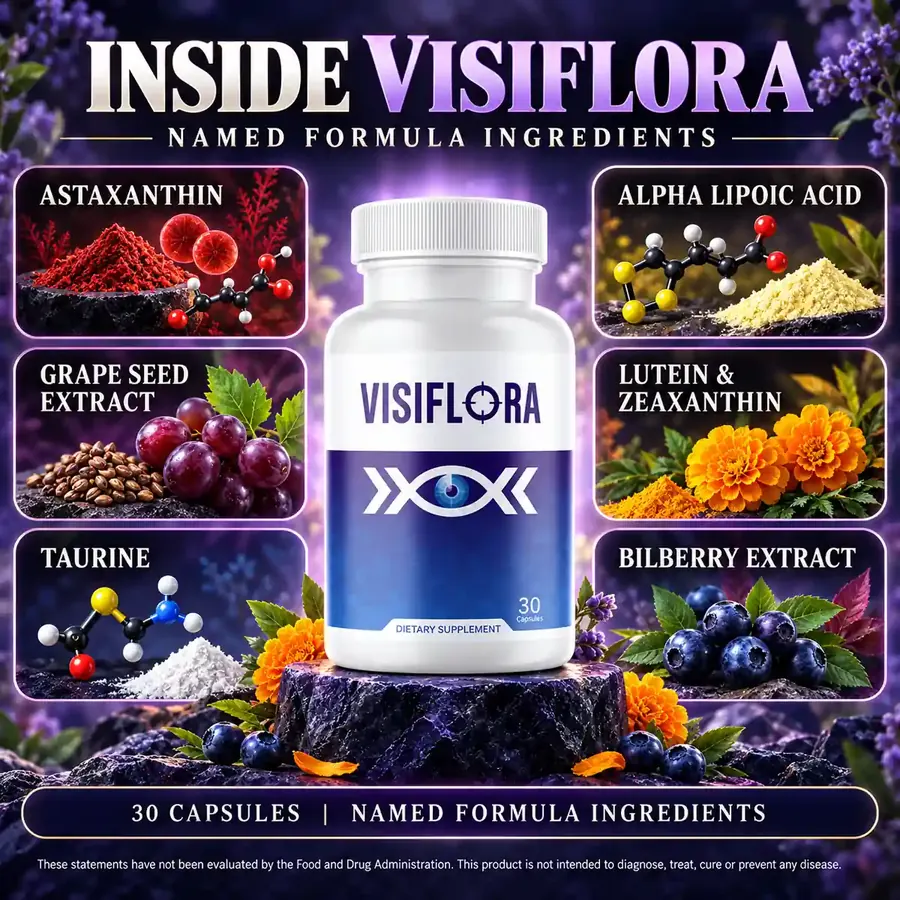
It is one of six ingredients on the brand's "Inside VisiFlora" graphic. Supplements usually sell it for tired eyes and focusing. It is not part of the AREDS2 formula, which uses lutein, zeaxanthin, vitamins C and E, zinc and copper (NEI: AREDS and AREDS2 formula doses).
The profile table below lines up the seller's listing with the research amounts.
| Name on the sales page | Astaxanthin |
|---|---|
| What it is | Red carotenoid, usually from algae |
| Type | Carotenoid |
| Amount per capsule | Not published |
| Amount used in research | 4 or 12 mg a day for 28 days in small eye-strain studies |
| Strength of evidence | Small, early human studies; mostly animal research |
| Why it is in the formula | Sold for eye strain and focusing |
| Main caution | No adverse events in the reviewed studies; the amount in VisiFlora is unknown. |
The studies
What does research say about astaxanthin and eye strain?
A few small human studies hint that it may ease eyestrain. A 2020 review found these studies used 4 or 12 mg a day for 28 days, but it said most of the evidence still comes from animals (Review: astaxanthin and the eye).
| Doses in human studies | 4 or 12 mg a day |
|---|---|
| Length of those studies | 28 days |
| What they suggested | Less eyestrain, or better focusing (accommodation) |
| Where most evidence comes from | Animal studies |
| Side effects reported | No adverse events in the clinical studies reviewed |
| The authors' verdict | More randomized and long-term clinical trials are needed |
Small and short studies are a starting point, not an answer. None of them tested VisiFlora.
Dose check
How much astaxanthin is in a VisiFlora capsule?
The amount is not published. A brand-issued advertorial confirms that zinc is the only ingredient with a stated quantity (Brand advertorial, ACCESS Newswire).
That matters here more than for most ingredients, because the research ties any effect to a dose. If a capsule holds 4 mg or more, it sits in the studied range. If it holds a small fraction of that, the studies say little about it. Nobody can tell which from the sales page.
Read the Supplement Facts panel on your bottle when it arrives. If astaxanthin is listed inside a "proprietary blend" with one total weight, the single amount stays hidden, which FDA rules allow for ingredients without a Daily Value (FDA: Supplement Facts and proprietary blends).
Claims, checked
Are the sales-page claims about astaxanthin backed by studies?
Not by any study the sales page cites. It makes a large strength comparison for astaxanthin, and it cites no research for it, so we do not repeat the number (Sales page, tryvisiflora.com).
The FTC says health claims need good evidence, usually from randomized human trials (FTC: health product advertising rules). A strength number with no source cannot be checked, and it is not a trial in people's eyes. The honest summary is the review's: possible benefit for eyestrain, more trials needed (Review: astaxanthin and the eye).
Read how we check every bottle and sales-page line on the claims page.
Try VisiFlora for 60 days1 capsule a day with food · from $49 a bottle · free U.S. shipping on 3 or 6 bottles
Order nowEveryday habits
What helps screen-tired eyes besides a supplement?
Breaks and blinking come first. Screen use can cut blinking by about a third to a half, which dries the eyes, and the strain usually eases with rest.
- Breakfast, about 8:00
One capsule with food, as the sales page directs. A meal also makes it easier to remember.
- Or dinner, about 6:30 pm
Pick one meal and keep it, so you never take a second capsule by mistake.
- Outdoors? Wear UV-blocking sunglasses
NEI advises lenses that block 99-100% of UVA and UVB.
- At screens: 20-20-20
Every 20 minutes, look 20 feet away for 20 seconds. A capsule cannot replace breaks.
Times are examples. Directions (Sales page, tryvisiflora.com); sunglasses (NEI: everyday ways to keep eyes healthy); screen breaks (AAO: screen time and eye strain tips).
The American Academy of Ophthalmology advises the 20-20-20 rule: every 20 minutes, look at something 20 feet away for 20 seconds (AAO: screen time and eye strain tips). In one study, blue-light filters did no better than plain neutral filters. These habits cost nothing and have better support than any capsule. More in our post on digital eye strain.
Know the signs
When is eye strain a reason to see an eye doctor?
See one if your eyes stay sore, gritty, red or blurry after rest. These can be signs of dry eye, which is more common after 50, in women, in contact lens users and in heavy screen users (NEI: dry eye).
- Strain that does not ease after a weekend away from screens
- Burning, scratchy or red eyes most days
- Blurry vision that comes and goes
- Trouble focusing up close that is new for you
A sudden shower of floaters, flashes of light or a shadow across your vision can mean retinal detachment. Go to an eye doctor or an emergency room right away (NEI: urgent warning signs).
Keep exploring
What other ingredients does VisiFlora list?
Twenty more, in seven other groups. Pick one below, or go back to the previous profile.
FAQ
Astaxanthin questions
Can astaxanthin ease tired, strained eyes?
It might, but the proof is thin. Small human studies at 4 or 12 mg a day for 28 days suggested less eyestrain, yet most evidence is from animals and the review authors call for more trials (Review: astaxanthin and the eye). Screen breaks are the better-supported first step (AAO: screen time and eye strain tips).
What dose of astaxanthin does each VisiFlora capsule hold?
The seller does not say. The sales page lists astaxanthin with no amount, and zinc at 11 mg is the only published quantity (Brand advertorial, ACCESS Newswire). Check the Supplement Facts panel on your own bottle and compare it with the 4 to 12 mg used in small studies (Review: astaxanthin and the eye).
Is astaxanthin safe to take every day?
The small eye studies in one review reported no adverse events (Review: astaxanthin and the eye). They were short, though, and VisiFlora's amount is unknown. Supplements can interact with medicines, so tell your doctor and pharmacist about everything you take, including VisiFlora (NCCIH: using supplements wisely). Stop and call them if anything feels off.
Do blue-light glasses help tired eyes?
Not much, based on one study the Academy reports. Blue-light filters did no better than neutral filters (AAO: screen time and eye strain tips). Blinking, the 20-20-20 rule and screen breaks are the advice the American Academy of Ophthalmology gives for screen-tired eyes. They cost nothing to try.
Is astaxanthin part of the AREDS2 formula?
No. AREDS2 uses vitamin C, vitamin E, zinc, copper, lutein and zeaxanthin, with no astaxanthin (NEI: AREDS and AREDS2 formula doses). That formula is for people with intermediate or late AMD (NEI: who AREDS supplements help). Astaxanthin research is about eyestrain and focusing, not AMD. The two should not be confused when you compare labels.
How long did the astaxanthin eye studies last?
The human studies in the 2020 review lasted 28 days (Review: astaxanthin and the eye). That is short, and long-term trials are still missing. VisiFlora itself has no published study, so judge how you feel within the 60-day money-back window and keep your regular eye exams.
Who wrote this
Written and reviewed by
Plain-language pages built from what the seller publishes and from linked eye-health sources.
Last updated . Read our editorial standards and how we check reviews. This website is run by a USA authorized VisiFlora retailer, not by the manufacturer. We earn money when you buy through our order links.
Keep reading
More about VisiFlora
Astaxanthin and eye strain
What small studies found about astaxanthin and tired eyes, the doses they used, and what VisiFlora does not publish.
Read more
Digital eye strain and 20-20-20
Why screens tire your eyes, how to set up the 20-20-20 rule, and what blue-light filters and capsules can and cannot do.
Read more
Claims, checked
Every VisiFlora claim beside the research: what is shown, what is early, and what is just marketing.
Read moreUSA authorized VisiFlora retailer
Ready to try VisiFlora?
Pick a pack. Every pack covers at least the 60-day money-back window at one capsule a day.
- Secure BuyGoods checkout
- 60-day money-back window
- Ships from the U.S. with tracking