Ingredient profile
Grape Seed, Rutin, Quercetin and Lycopene in VisiFlora
VisiFlora lists grape seed extract, rutin, quercetin and lycopene, all plant compounds sold as antioxidants. None has a published amount. Grape seed may have modest effects on blood pressure and cholesterol, though not definite, and the sources we cite give no eye data for any of the four. They are not part of AREDS2.
Written by the VisiFlora editorial teamUpdated
The basics
What is grape seed extract in VisiFlora?
It is an extract made from grape seeds (Vitis vinifera). VisiFlora's sales page lists "Grape Seed Extract" and gives no amount (Sales page, tryvisiflora.com).
Grape seed is one of the six headline ingredients on the brand graphic. The seller presents it as an antioxidant for circulation. This page also covers three smaller plant compounds from the same list: rutin, quercetin and lycopene.
| Name on the sales page | Grape Seed Extract |
|---|---|
| What it is | Vitis vinifera seed |
| Type | Plant extract |
| Amount per capsule | Not published |
| Amount used in research | Small studies on blood pressure and cholesterol |
| Strength of evidence | Possible modest effects, not definite; no eye studies cited |
| Why it is in the formula | Sold as an antioxidant for circulation |
| Main caution | Generally well tolerated. Tell your doctor about it if you take medicines. |
The evidence
Does grape seed extract help your eyes?
There is no eye evidence in the sources we cite. NCCIH's grape seed page does not discuss eye conditions at all (NCCIH: grape seed extract).
What NCCIH does cover is the heart side. Reviews of small studies suggest grape seed may have modest effects on cholesterol and blood pressure. NCCIH adds that these conclusions should not be considered definite.
So grape seed in VisiFlora is a general antioxidant, not an eye ingredient with trial support. It is not part of the AREDS2 formula either (NEI: AREDS and AREDS2 formula doses).
Rutin and quercetin
What are rutin and quercetin in VisiFlora?
They are flavonoids, a large family of plant compounds. The sales page names both and sells them to support small blood vessels, but it cites no study and gives no amounts (Sales page, tryvisiflora.com).
| Name on the sales page | Rutin; Quercetin |
|---|---|
| What it is | Plant flavonoids |
| Type | Flavonoids |
| Amount per capsule | Not published |
| Amount used in research | No eye research among the sources we cite |
| Strength of evidence | Not established for eyes |
| Why it is in the formula | Sold to support small blood vessels |
| Main caution | The sales page makes claims for them without citing a study. |
We found no eye research on rutin or quercetin among the sources this site relies on. That does not prove they do nothing. It means we cannot honestly tell you they help your eyes, or at what dose. The FTC expects health claims to rest on human trials, which the sales page does not offer here (FTC: health product advertising rules).
Lycopene
Why is lycopene in an eye supplement?
The sales page includes it as an antioxidant, but gives no eye study for it. Lycopene is the red carotenoid found in tomatoes, and it was not part of either AREDS formula (NEI: AREDS and AREDS2 formula doses).
| Name on the sales page | Lycopene |
|---|---|
| What it is | Red carotenoid found in tomatoes |
| Type | Carotenoid |
| Amount per capsule | Not published |
| Amount used in research | Not part of AREDS or AREDS2 |
| Strength of evidence | Not established for eyes |
| Why it is in the formula | Sold as an antioxidant |
| Main caution | Tomatoes and tomato products are everyday food sources. |
Tomatoes and tomato products are everyday sources. If you like them, they are an easy part of a varied diet. The eye-specific value of a lycopene capsule is not shown by any source we cite.
Side by side
What is known and not known about these four ingredients?
For grape seed, a little is known about the heart and nothing about the eyes. For rutin, quercetin and lycopene, our sources say nothing about eye effects or safety at all.
| Ingredient | Amount | What our sources say | Not known |
|---|---|---|---|
| Grape seed extract | Not published | Possible modest blood pressure and cholesterol effects; generally well tolerated (NCCIH: grape seed extract) | Any eye effect |
| Rutin | Not published | Named on the sales page (Sales page, tryvisiflora.com) | Eye effects and safety at this dose |
| Quercetin | Not published | Named on the sales page (Sales page, tryvisiflora.com) | Eye effects and safety at this dose |
| Lycopene | Not published | Not in AREDS or AREDS2 (NEI: AREDS and AREDS2 formula doses) | Eye effects and safety at this dose |
Try VisiFlora for 60 days1 capsule a day with food · from $49 a bottle · free U.S. shipping on 3 or 6 bottles
Order nowRead the formula
Where do these ingredients show up in what the seller lists?
On one line, together with taurine and alpha-lipoic acid, all marked amount not published. Tap a line to read what it means.
What the seller lists
Typed from the sales page · No Supplement Facts panel is published
The sales page direction. The brand graphics show 30 capsules per bottle, so one bottle lasts about 30 days.
The only amount the seller publishes. It equals the RDA for men (8 mg for women), is far under the 40 mg upper limit, and is far below the 80 mg used in AREDS.
AREDS2 used 10 mg of lutein and 2 mg of zeaxanthin. Without amounts, no one can compare VisiFlora with it.
Small eye-strain studies used 4 to 12 mg a day. Most astaxanthin research is in animals.
Rigorous trials found no night-vision benefit in healthy people.
AREDS2 left beta-carotene out. The original AREDS formula with beta-carotene is not recommended for current or former smokers.
AREDS2 used vitamin C 500 mg, vitamin E 400 IU and copper 2 mg.
Ginkgo may raise bleeding risk with warfarin and other blood thinners.
Alpha-lipoic acid may lower blood sugar and add to diabetes medicines.
The sales page claims 22 ingredients and names 21. No probiotic is named, despite the gut-eye pitch.
Not published. The capsule shell and any fillers are not listed.
Typed from the sales page (Sales page, tryvisiflora.com), not from a label photo. Check the panel on your own bottle.
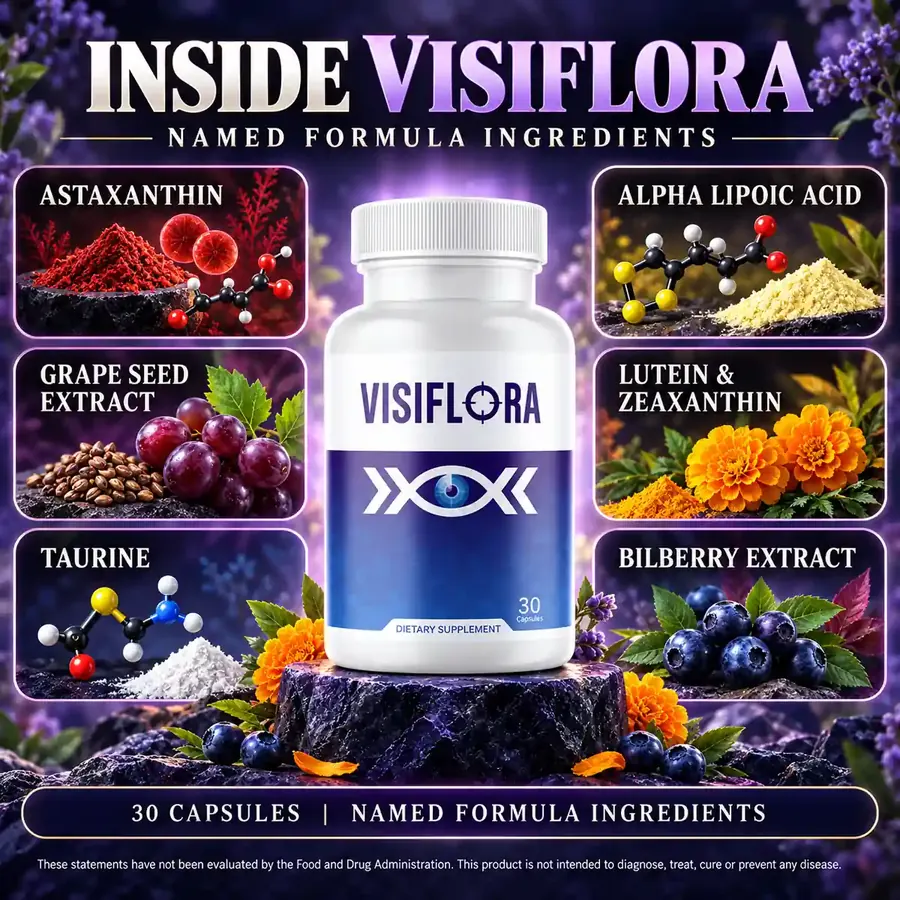
Tap a line to see what it means. The brand graphic names six headline ingredients and shows 30 capsules; it gives no amounts.
Safety
Are grape seed, rutin, quercetin and lycopene safe with medicines?
Grape seed extract is generally well tolerated, according to NCCIH (NCCIH: grape seed extract). For rutin, quercetin and lycopene, our sources give no safety data, so we will not guess at side effects.
The general rule still applies. Any supplement can interact with a medicine, and plant-based is not a synonym for safe (NCCIH: using supplements wisely). Show your pharmacist the bottle if you take any prescription. Read the full side effects and interactions page for the formula as a whole.
Keep exploring
Which VisiFlora ingredient profile should you read next?
Taurine comes next. Every group is one tap away.
FAQ
Grape seed and flavonoid questions
Does grape seed extract help your eyes?
No eye benefit is shown in the sources we cite. NCCIH's grape seed page does not discuss eye conditions, and covers only possible modest effects on cholesterol and blood pressure that it calls not definite (NCCIH: grape seed extract). VisiFlora does not publish its grape seed amount either.
How much grape seed extract is in VisiFlora?
The seller does not publish it. Grape seed is one of the brand's six headline ingredients, yet zinc at 11 mg is the only amount on the sales page (Brand advertorial, ACCESS Newswire). Check the Supplement Facts panel on your bottle when it arrives.
Do rutin and quercetin help eyesight?
We cannot say they do. The sales page names both but cites no study, and none of the sources this site relies on covers their eye effects (Sales page, tryvisiflora.com). Health claims need human trials to back them (FTC: health product advertising rules). Their amounts in VisiFlora are not published either.
Why is lycopene in VisiFlora?
The seller includes it as an antioxidant, but gives no study for it. Lycopene is the red pigment in tomatoes, and it was not part of the AREDS or AREDS2 formulas tested for AMD (NEI: AREDS and AREDS2 formula doses). Its amount in VisiFlora is not published.
Is grape seed extract safe?
NCCIH says grape seed extract is generally well tolerated (NCCIH: grape seed extract). The amount in VisiFlora is unknown, and supplements can interact with medicines. Tell your doctor and pharmacist about VisiFlora, especially if you take several prescriptions (NCCIH: using supplements wisely). Bring the bottle to your next visit.
Can grape seed extract lower blood pressure?
Possibly a little, but it is not settled. Reviews of small studies suggest modest effects on blood pressure and cholesterol, and NCCIH says those findings should not be considered definite (NCCIH: grape seed extract). Never use a supplement in place of blood pressure medicine.
Who wrote this
Written and reviewed by
Plain-language pages built from what the seller publishes and from linked eye-health sources.
Last updated . Read our editorial standards and how we check reviews. This website is run by a USA authorized VisiFlora retailer, not by the manufacturer. We earn money when you buy through our order links.
Keep reading
More about VisiFlora
Ingredients
All 21 named ingredients in 12 groups, with research amounts and the main caution for each.
Read moreSide effects
Which VisiFlora ingredients carry known cautions, which medicines to check, and what to do if you feel unwell.
Read moreEye supplement red flags
The FDA and FTC warning signs for eye supplements, how to read a label and reviews, and how VisiFlora measures up.
Read moreUSA authorized VisiFlora retailer
Ready to try VisiFlora?
Pick a pack. Every pack covers at least the 60-day money-back window at one capsule a day.
- Secure BuyGoods checkout
- 60-day money-back window
- Ships from the U.S. with tracking